

Ensuring women’s safety is a cornerstone of a progressive and just society. As we move into 2025, the landscape of women’s safety in India has evolved, with the government implementing significant policies to protect and empower women. At Sarva Hitam Manav Seva Sansthan, we work closely with communities to advocate for women’s rights, self-defense, and access to essential resources. This blog explores the key government initiatives supporting women’s safety and how they align with our mission.
Strengthening Laws and Legal Framework
The Indian government has continuously strengthened its legal framework to enhance women’s safety. Some of the most significant laws and amendments in recent years include:
-
The Criminal Law (Amendment) Act, 2023
This act introduced stricter penalties for crimes against women, including:
- Sexual harassment: Harsher punishment for workplace and public harassment, including digital harassment.
- Domestic violence: A more structured mechanism for immediate legal protection and rehabilitation of victims.
- Acid attacks: Stringent monitoring of the sale of hazardous substances and increased compensation for survivors.
- Fast-track courts: Expedited trials for cases related to crimes against women to ensure swift justice.
-
Anti-Cyber Harassment Laws
With the rise of digital crimes, new amendments under the IT Act aim to curb:
- Cyberstalking and online harassment: Stricter penalties for digital crimes against women.
- Circulation of explicit content without consent: Severe punishment for offenders who exploit women online.
- Fake social media accounts and impersonation: AI-based tracking mechanisms to detect and remove fake profiles used for harassment.
-
The Women’s Reservation Bill
While primarily aimed at increasing political representation, this bill ensures that women are actively involved in decision-making bodies, leading to more policies focusing on gender-sensitive governance and safety measures.
Government-Backed Safety Initiatives
Recognizing the importance of preventive measures, several government programs have been launched to protect women in both public and private spaces.
- Safe City Project
This initiative, launched in major metropolitan areas, enhances women’s security through:
- AI-powered surveillance systems and increased patrolling.
- GPS-enabled street lighting and emergency alert systems.
- Deployment of women police officers at key public locations. ● Gender-sensitive urban planning to eliminate isolated and unsafe areas.
- One Stop Centres (OSCs)
These centers provide comprehensive support to women facing violence by offering:
- Medical assistance: Immediate healthcare support for survivors of violence. ● Legal aid: Access to legal representatives and assistance in filing cases. ● Psychological counseling: Mental health support to help victims recover from trauma.
- Rehabilitation and shelter services: Safe housing for women escaping violence.
- Nirbhaya Fund
The Nirbhaya Fund, established in 2013, has been strengthened in 2025 to focus on:
- Expanding emergency helplines and integrating them with law enforcement agencies.
- Funding self-defense training programs in schools and colleges. ● Enhancing technology-driven safety solutions such as AI-based monitoring of distress calls.
- Installing panic buttons in public transport for immediate assistance. 4. Women Helpline 181
A nationwide 24/7 helpline providing assistance in cases of:
- Domestic violence
- Sexual harassment
- Human trafficking and forced labor
- Mental health crises related to gender-based violence
Technology for Women’s Safety
With the integration of advanced technology, women’s safety is receiving a much-needed boost. In 2025, the government has introduced:
- AI-Based Safety Apps
- Real-time location tracking and automatic distress signal transmission. ● Voice-activated emergency alert systems integrated with law enforcement databases.
- Community support features where women can alert nearby users for immediate help.
- CCTV Monitoring in Public Spaces
- Smart surveillance systems powered by AI detect suspicious activities in real-time.
- Integration with facial recognition technology to track known offenders. ● Deployment in high-risk areas such as metro stations, bus stops, and markets.
- GPS Tracking in Public Transport
- Real-time monitoring of buses and taxis, allowing passengers to share their routes with emergency contacts.
- Female-only transport services in major cities.
- Public transport marshals to oversee women’s security.
Our Role in Society
At Sarva Hitam Manav Seva Sansthan, our commitment extends beyond initiatives—we aim to create lasting social change. Through our various projects, we address some of the most pressing challenges faced by women and young girls, ensuring they are empowered, protected, and heard. Our work is not just about assistance; it is about transformation, where every step we take is a step towards a safer, more equitable society.
- Nidar Betiyan – Empowering Girls with Strength and Confidence
In collaboration with the Delhi Police, Nidar Betiyan is more than just a self-defense training program—it is a movement towards instilling courage and resilience in young girls. With the rising need for personal safety, we train school and college students in self-defense techniques, helping them develop confidence and the ability to protect themselves in challenging situations.
- Our workshops are conducted in schools, colleges, and community centers, ensuring accessibility to all.
- Beyond physical defense, we focus on mental strength and awareness, educating girls on their rights, safety laws, and emergency response mechanisms.
- This initiative is not just about protection but about prevention, encouraging a mindset where girls feel empowered rather than vulnerable.
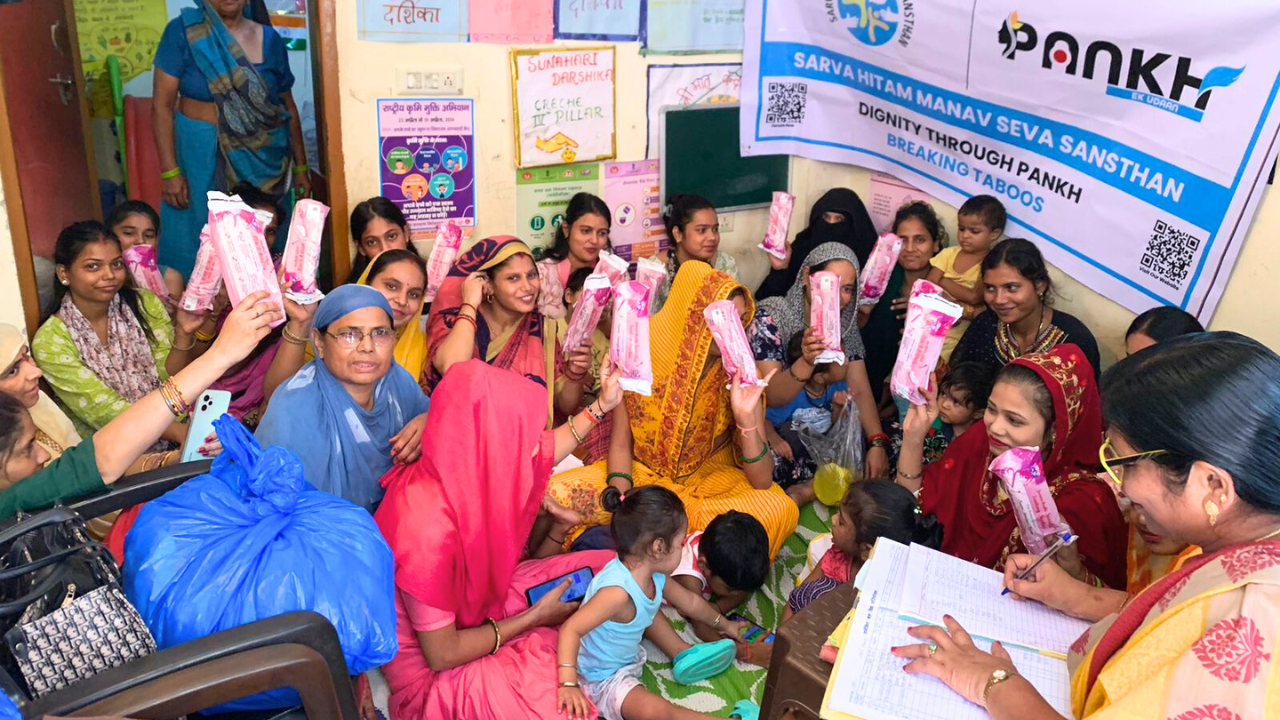
- Pankh: Ek Udaan – Redefining Menstrual Health and Dignity
The stigma surrounding menstruation still limits opportunities for many girls, affecting their education and overall well-being. Through Pankh: Ek Udaan, we actively break these barriers by promoting menstrual hygiene awareness and ensuring access to safe sanitary products.
- We distribute biodegradable sanitary pads to adolescent girls, minimizing health risks and promoting sustainability.
- Our initiative advocates for stronger health and safety policies that prioritize menstrual hygiene as an essential right, not a privilege. ● By conducting interactive awareness sessions, we create safe spaces for conversations on menstrual health, enabling girls to manage their periods without fear or shame.
- Dilli Ke Diller – Standing Against Gender-Based Violence
Violence and harassment against women remain critical issues in society, but awareness and action can be powerful tools in preventing them. Dilli Ke Diller is an activism-driven campaign aimed at educating communities about gender-based violence, inspiring a culture of zero tolerance.
- We conduct street plays, awareness drives, and community engagement programs to educate people on recognizing and responding to violence. ● A key focus is on bystander intervention, empowering citizens to step up and act when they witness harassment or abuse.
- We work towards strengthening reporting mechanisms, ensuring that victims feel safe and supported in seeking justice.
Each of these initiatives is driven by the belief that real change begins when communities unite for a cause. Through education, empowerment, and action, we
continue to play our role in building a society where every girl and woman can thrive without fear, where their safety, dignity, and rights are non-negotiable.
Case Study: Archana’s Path Towards a Better Life
In the heart of Delhi’s marginalized communities, where silence often overshadows struggles, one voice dared to rise. Archana, a young woman from a small village in Uttar Pradesh, never imagined she would become a beacon of change. When she first attended our Pankh: Ek Udaan session, she was just another participant—curious, hesitant, and uncertain about her role in the larger fight for awareness.
But something shifted that day. Her questions about menstrual hygiene weren’t just inquiries; they were sparks of a deeper calling. As she listened, she realized that the stigma around menstruation wasn’t just a social issue—it was a chain holding women back, including herself.
Yet, breaking free wasn’t easy. Archana had never spoken in front of a crowd, let alone led a movement. Confidence was her biggest battle. But at Sarva Hitam Manav Seva Sansthan, we saw the fire within her. Through mentorship, training,
and encouragement, we helped her find her voice. And when she did, it echoed across communities.
From a hesitant attendee to a fierce advocate, Archana began conducting awareness sessions in Saheli Samanvay Kendras, working alongside government officials, and touching the lives of nearly 1,000 women. She became more than an educator—she became a role model, proof that empowerment starts with awareness and the courage to step forward.
Today, she stands tall, not just as a leader but as a force of transformation. The same girl who once doubted herself is now lifting others, breaking barriers, and rewriting the narrative for countless women.
Archana’s journey is living proof of the power of belief—belief in oneself, in change, and in the extraordinary potential that every woman carries within.
What More Needs to Be Done?
While these policies and initiatives are steps in the right direction, continuous efforts are needed to create a truly safe environment for women in India. We urge:
- Stronger implementation of existing laws: Policies must translate into action, with strict monitoring mechanisms in place.
- More community-driven initiatives: Grassroots organizations like ours need greater support to implement safety programs at the local level. ● Increased public awareness: Educational campaigns must be strengthened to encourage a culture of respect and equality.
- More employment opportunities for women: Economic empowerment plays a key role in ensuring women’s independence and safety. ● Safer infrastructure in rural areas: Improved lighting, public transport, and security measures must extend beyond cities.
Conclusion
As we are progressing in the year 2025, the issue of women’s safety stands at a critical juncture. While government policies and legal frameworks are laying the foundation for a safer future, true transformation requires more than just legislation—it demands collective action. Safety is not merely a right; it is a shared responsibility that extends to every member of society.
At Sarva Hitam Manav Seva Sansthan, we believe that meaningful change begins when communities unite, individuals take action, and organizations work hand-in-hand with authorities to build an environment where women feel secure, respected, and empowered. Our initiatives—ranging from self-defense training to menstrual hygiene awareness and gender-based violence prevention—are designed not only to address immediate concerns but also to foster long-term societal change.
However, our efforts alone are not enough. We need you—as an individual, as a part of a community, and as an agent of change—to contribute in whatever way possible. Whether it is by raising awareness, standing against injustice,
supporting initiatives, or educating the next generation, every action counts in shaping a future where safety is not a privilege but a guarantee.
When women are safe, society thrives. A secure environment for women leads to stronger families, healthier communities, and a more progressive nation. Let us commit to making 2025 a year of action, accountability, and advancement toward a world where every woman can live, work, and dream without fear.
Join us in this mission—because together, we can make a difference.